Clan Lamont is one of the most ancient Clans in Scotland, tracing its geneology back as far as the 6th Century to the first Scottish kingdom of Dalriada. The Clan Lamont flourished through the centuries, marrying into the finest Viking families, which produced a strong Celtic-Norse bloodline. The name Lamont derives from the Norse "lagman" meaning a lawman or judge, an honoured position reserved for only the wisest of men. The earliest recorded Lamont chief is Ferchar, who lived amid the glorious splendour of the Holy Loch in 1200. It was Ferchar's grandson, Lauman, who founded the Clan stronghold of Toward Castle at Inveryne, which is situated on the banks of Loch Fyne. Lauman headed the senior line of heriditary judges in Cowal in the mid 13th Century, nobly presiding over the many conflicts which arose in such a turbulent age.
Clan Lamonts' influence increased down through the years by careful alliances with the most mighty Clans in Scotland. Lamonts married into the powerful Clan Donald of the Isles during the 14th and 15th Centuries, which led to the Clan Lamont expanding into the Isle of Bute. While the Clan remained firmly entrenched in Cowal, Lamonts also settled in Galloway, Ayrshire, and Fife. Clan Lamont was also favoured by the House of Stewart, who for centuries had neighboured the Lamonts on the Firth of Clyde, before they ascended to the throne.
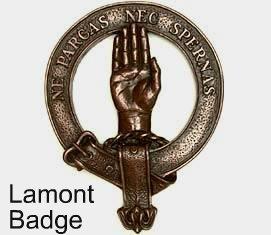
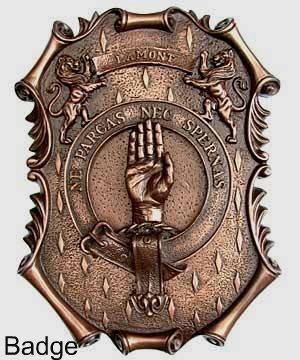
Lamonts have been just as outstanding in Scottish literature as they have been in music. The late Reverend Donald Lamont was the most prominent writer of Gaelic prose in Scotland until he passed away in 1958. However, the Lamonts' cultural endowments were not limited to the bonnie shores of Scotland. The eminent Bavarian scientist Johann von Lamont was actually John Lamont, born in 1805, the brilliant son of a Braemar forester. The Clan Lamont crest is a raised hand, and the motto reads "Ne parcas nec spernas", meaning in Latin, "Neither spare nor dispose". The 28th Chief of Clan Lamont resides in Australia.